The Invisible Step: Why Your £40k Garden Becomes Dangerous After Dark
Your £40k garden looks brilliant during the day. At night, those grey porcelain steps can virtually disappear. Here's why lighting needs designing before the patio goes down.
You've spent forty grand landscaping the garden.
Big porcelain patio. Raised seating area. Steps down to the lawn. Retaining walls. Everything looks sharp during the day.
Then it gets dark.
You walk across the patio, don't see the change in level and nearly go straight over.
That's when you discover somebody designed your expensive new garden entirely for the photographs.
Grey Porcelain Hides Everything at Night
Split-level gardens work because your eyes can see where one surface finishes and another begins.
During daylight, that's easy.
At night, things change.
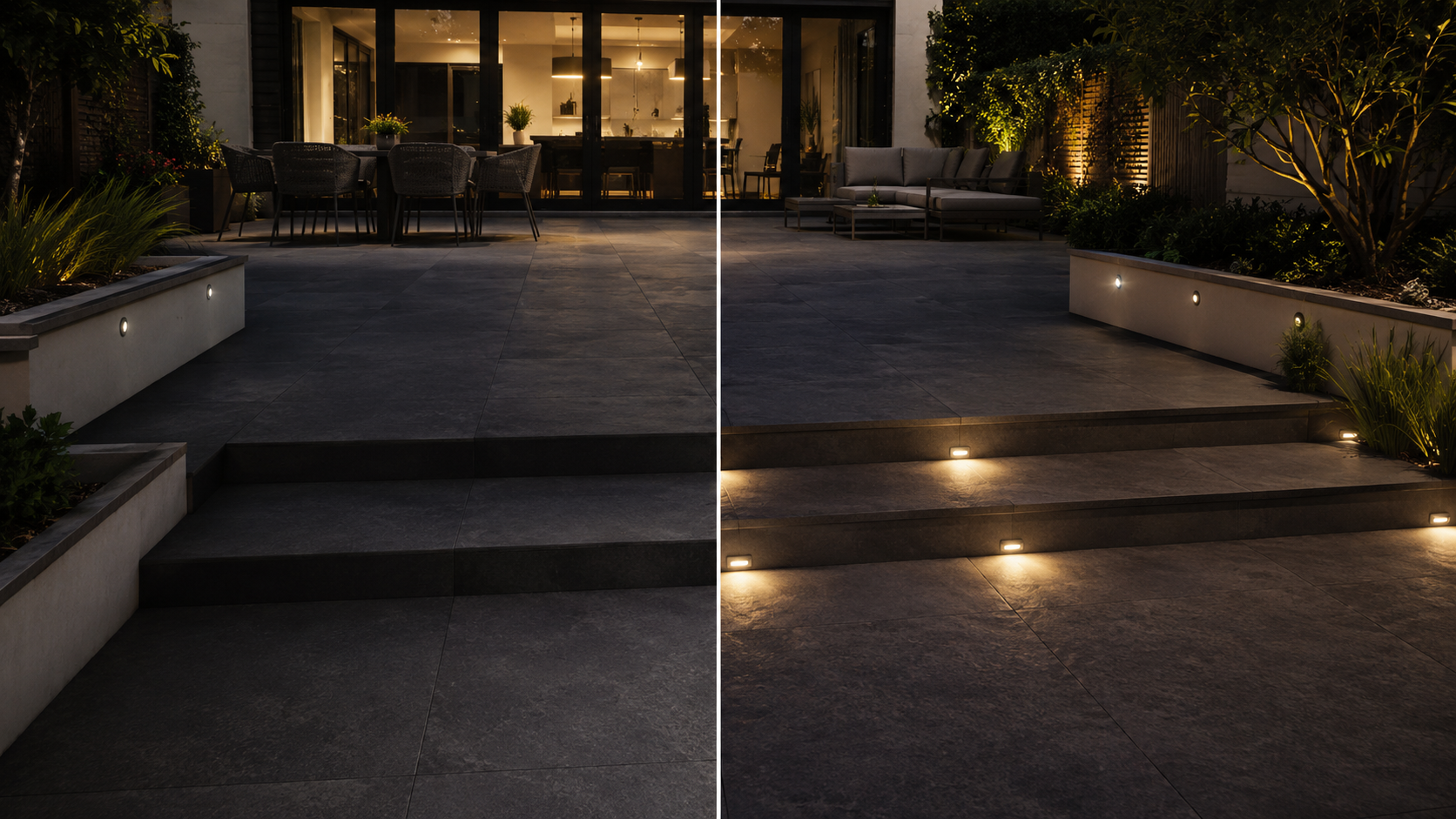
Put the same dark grey porcelain across the patio, steps and lower terrace and those separate levels can start looking like one flat surface.
Shadows make it worse. So does badly positioned lighting.
You don't need a massive staircase to create a problem either. One unexpected step is enough to send somebody flying with a glass in their hand.
This is why lighting needs designing around the landscaping. Not added afterwards because somebody remembered gardens get dark.
More Light Doesn't Automatically Make it Safer
Here's the cheap solution.
Stick a massive floodlight on the house.
Garden's bright. Problem solved.
Except now you're being blinded every time you look towards it.
Badly positioned lights create glare and harsh shadows. You can actually make changes in level harder to read because your eyes are constantly adjusting between bright and dark areas.
We want light where it does a job.
Recessed lights can identify the face of a step. Carefully positioned fittings can pick out an edge or level change without turning the garden into a supermarket car park.
The point isn't to make everything bright.
It's to make the layout obvious.
The Cable Goes In Before the Porcelain
This is the bit people forget.
Proper garden step lighting needs power.
And we'd quite like the cables hidden.
That means the lighting plan needs sorting while we're doing the groundworks.
Routes can be prepared. Suitable external cabling and ducting can go underground. Positions for fittings can be worked into steps and walls before everything gets finished.
Do it the other way around and you've got a problem.
The porcelain is down. The walls are rendered. The pointing is finished.
Now somebody decides they want six recessed step lights.
Where's the cable going?
You either start cutting into your brand-new landscaping or run ugly surface wiring across something you've just spent thousands making clean.
We've already written about why proper outdoor electrics matter. This is the design side of the same problem.
You plan it before you build it.
We Design the Garden for 10pm as Well
A premium garden shouldn't stop working when the sun goes down.
When we're designing different levels, we're thinking about how people actually move through them.
Where are the steps?
Where will somebody naturally walk from the house?
Which edges disappear in darkness?
Where does lighting help, and where would it just shine straight into somebody's face?
Get those decisions right at the start and the finished lighting looks simple.
That's usually a sign somebody thought about it properly.
Because if you've spent £40,000 creating a garden for entertaining, having your first guest go arse over tit down an invisible porcelain step isn't much of a finishing touch.
Stop letting cheap builders ruin your property. Pop down and see the lads at 78 Alma Rd, Bournemouth BH9 1AN, UK, or ring the site phone on 07840 151036.