The £15k Kite: Why Coastal Pergolas Need Serious Foundations
A £15k aluminium pergola might look indestructible, but coastal wind can put serious force through its posts and fixings. Bolt it into the wrong base and you've built an extremely expensive kite.
You've spent £15,000 on an aluminium louvred pergola.
Big posts. Heavy frame. Motorised roof. The thing looks like it could survive a bomb going off.
Then a proper coastal storm comes through Sandbanks.
Suddenly those four innocent-looking posts are trying to hold down a bloody great aluminium kite.
The pergola itself might be beautifully engineered. Doesn't matter much if somebody has fixed it to a few paving slabs and hoped the weight would keep it there.
Heavy Doesn't Mean Anchored
This is where people get caught out.
An aluminium pergola feels incredibly solid when you're standing underneath it. There's a lot of metal there, so naturally people assume the weight makes it safe.
Wind doesn't care how expensive it was.
Get air moving across and underneath a large roof structure and you've got forces trying to lift, twist and push the whole thing around.
Then you've got leverage.
The wind is acting several metres above the ground, while the fixings at the bottom of those posts are trying to resist everything.
A tiny bit of movement at the base becomes a much bigger problem at the top.
Four Porcelain Slabs Aren't Foundations
Here's the shortcut.
Patio gets built first.
Pergola arrives afterwards.
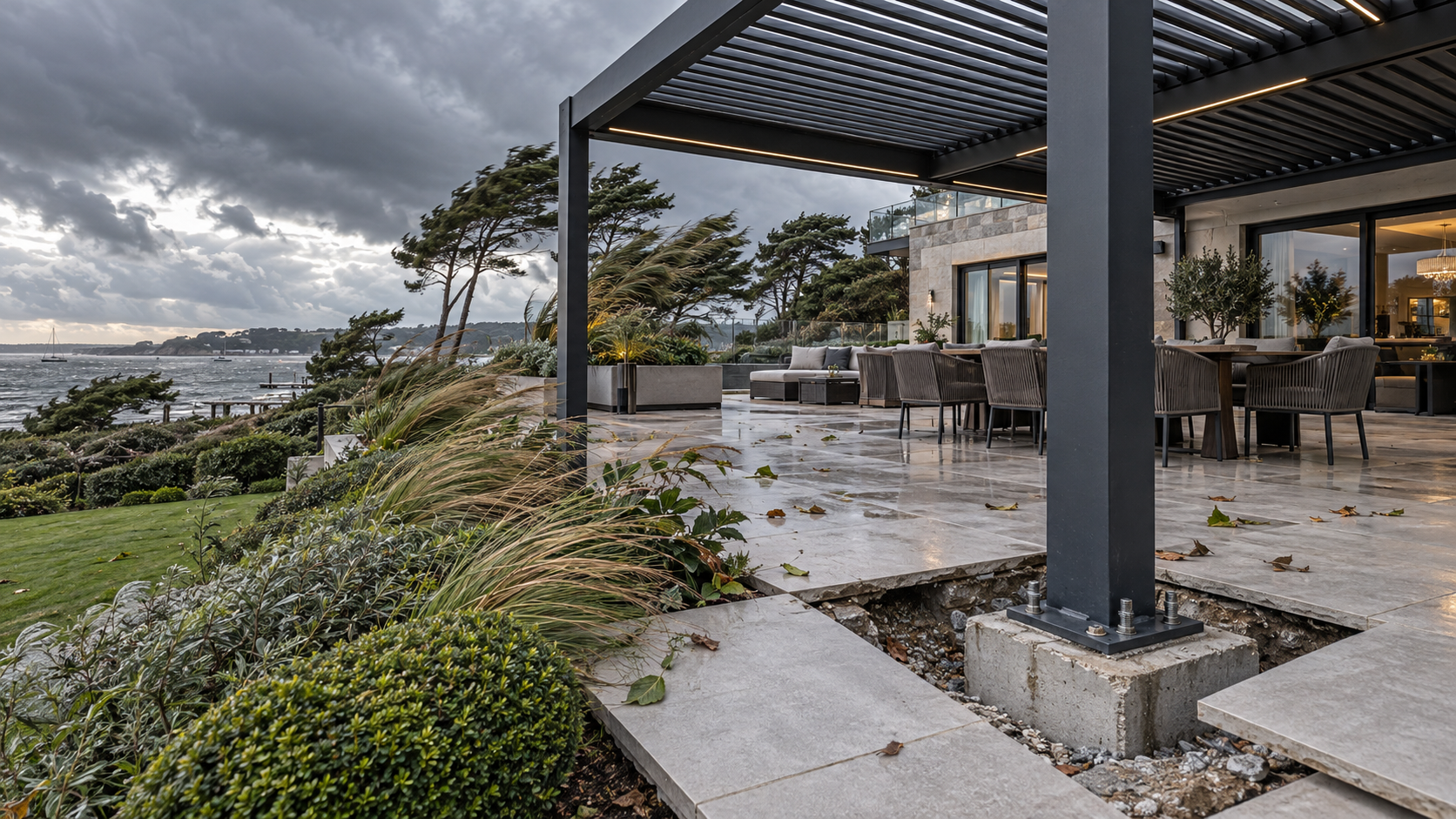
Installer decides where the posts need to sit, drills through the porcelain and bolts them down.
Looks tidy.
But what are those bolts actually fixed into?
A 20mm porcelain slab isn't a structural foundation. Neither is a normal patio mortar bed underneath it.
You can have a £15,000 pergola held down by something originally designed to support people walking across the garden.
That's backwards.
The load from the pergola needs transferring into something underneath capable of dealing with it.
That means the foundations should be considered before the finished paving goes anywhere near the site.
Sandbanks Gives It a Proper Test
Coastal gardens around Sandbanks and Poole can be exposed.
You haven't necessarily got rows of buildings, mature hedges and sheltered streets taking the sting out of the weather.
When the wind gets going, exposed structures feel it.
That's why pergola installation in Sandbanks can't just be treated like assembling expensive garden furniture.
Position matters. Exposure matters. The size and design of the pergola matter. The manufacturer's fixing requirements matter.
And the ground underneath definitely matters.
We're not interested in finding out whether the foundations were good enough during the first serious storm.
Build the Foundation Before the Showpiece
This is the same principle we use across proper landscaping.
The expensive bit you can see is normally relying on something boring underneath it.
Before a pergola arrives, we want to know where the posts are going and what they're being fixed to.
Foundations can then be incorporated into the groundworks and hidden within the finished landscaping.
Porcelain goes down.
Pergola goes up.
Everything looks clean.
The difference is those beautiful aluminium posts aren't relying on a couple of paving slabs to stop £15,000 worth of garden structure trying to leave Dorset.
Stop letting cheap builders ruin your property. Pop down and see the lads at 78 Alma Rd, Bournemouth BH9 1AN, UK, or ring the site phone on 07840 151036.