The Fake Permeable Driveway: Why the Rain is Still Sitting on Top
Paid extra for a permeable driveway but rain is still sitting on top? The blocks are only one part of the system. Wrong sub-base, clogged joints and poor groundworks can stop the whole thing draining.
You paid extra for a permeable driveway.
The whole point was simple. Rain hits the drive, passes through it and disappears into the construction underneath instead of running towards the pavement or sitting in puddles.
Two years later, it's absolutely hammering down in Bournemouth and you've got water sitting across the blocks.
So much for permeable.
The problem is that sticking permeable blocks on top doesn't magically create a permeable driveway. The whole thing has to work as a system, right down into the ground.
The Water Has to Go Somewhere
A proper permeable driveway works differently from standard block paving.
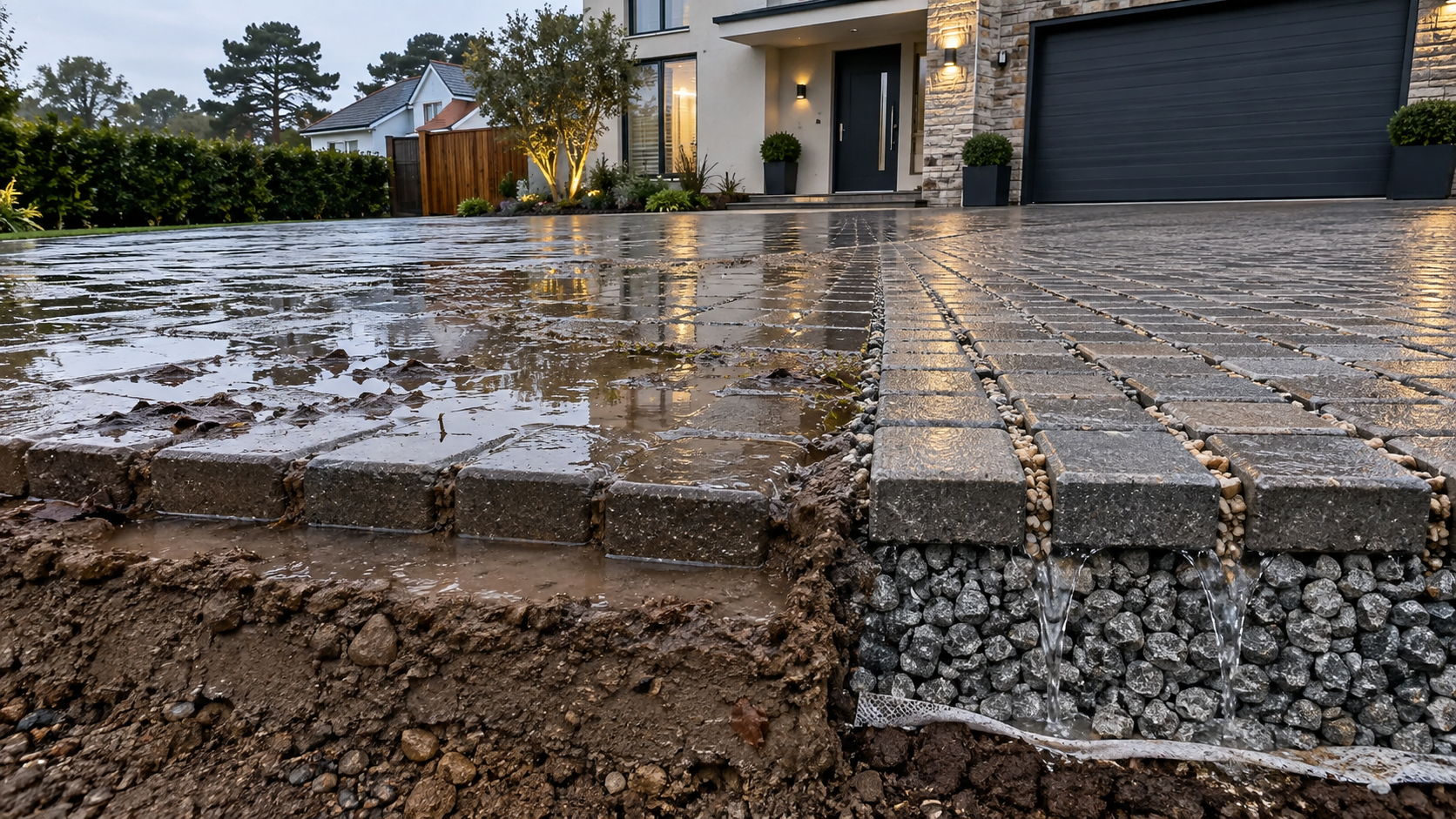
Water needs to pass through the joints, through the laying course and into an open-graded sub-base below. That stone contains voids where water can move and temporarily sit before soaking into suitable ground or being dealt with by the designed drainage system.
Now imagine somebody builds it like a normal driveway.
Standard dense sub-base gets compacted underneath. Wrong laying material goes on top. Permeable blocks get fitted because that's what the customer ordered.
Looks lovely.
But you've basically put a drainage surface over a plug.
When the rain arrives, there's nowhere for the volume of water to go quickly enough.
Then the Joints Get Full of Muck
Even a properly constructed permeable surface needs looking after.
Those joints are part of the drainage system. Fill them with fine dirt, silt, moss and years of driveway muck and you've started blocking the route the water uses to get underground.
This is where people make things worse.
Some bloke repairs a section and sweeps ordinary kiln-dried sand into the joints because that's what he's always used on block paving. Or somebody throws unsuitable fine material across the surface.
You've now taken gaps designed to let water through and started filling them with material that can restrict it.
The driveway hasn't suddenly stopped being permeable.
You've clogged it.
Permeable Doesn't Mean Weak
There's another reason cowboys get this wrong.
They hear "water needs to pass through it" and assume the base can't be properly constructed.
Wrong.
You've still got cars driving over the thing every day. Modern SUVs and EVs aren't exactly light either.
The driveway needs enough excavation, suitable open-graded stone, proper compaction and the correct laying system to support that weight while still leaving routes for water to move.
That's the clever bit.
You need strength without sealing everything solid.
Chuck a few bags of stone into a shallow hole and you've got drainage but a rubbish driveway. Compact the wrong material into a solid lump and you've got strength but nowhere for the water to go.
Neither is a properly designed permeable driveway.
Build the Drainage Under the Drive
This is why we bang on about groundworks.
The expensive blocks are the bit you see.
The important stuff is underneath them.
Before we're interested in colours and borders, we want to know what ground we're dealing with, where the water can go, what loads the driveway needs to carry and how the entire construction is going to behave during a proper Dorset downpour.
Because selling somebody a "permeable driveway" is easy.
Building one that still drains properly years later takes a bit more than buying the right blocks.
Stop letting cheap builders ruin your property. Pop down and see the lads at 78 Alma Rd, Bournemouth BH9 1AN, UK, or ring the site phone on 07840 151036.