The Cold Stripe: Why Your Garden Office Gets Mould in Perfectly Straight Lines
Mould appearing in perfectly straight lines inside your garden office isn't random. Cold spots and thermal bridging can create condensation exactly where the insulation should be protecting you.
Your garden office is insulated.
Heating works. Roof doesn't leak. Walls feel warm.
Then winter arrives in Bournemouth and something weird starts happening.
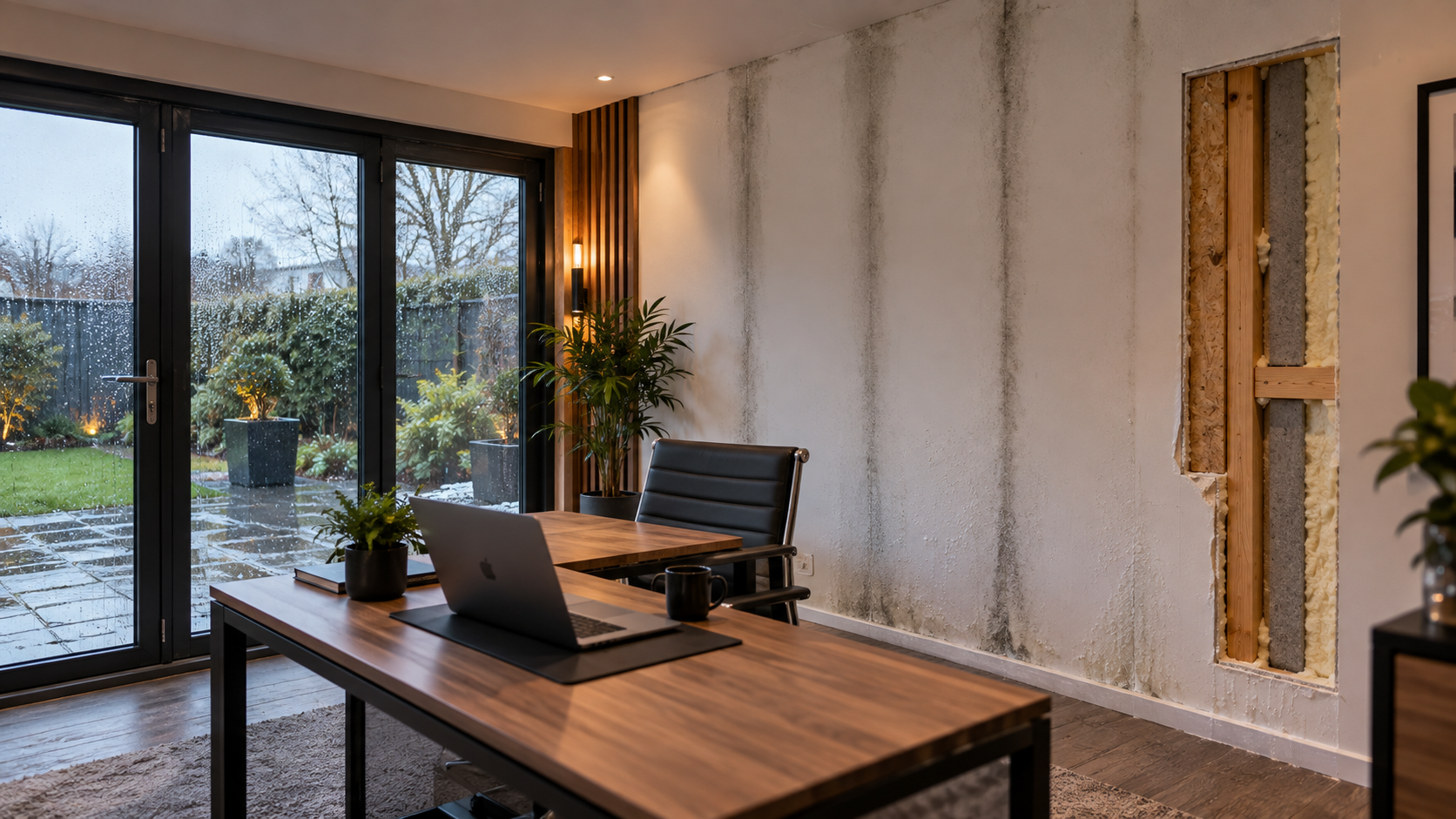
Dark marks appear on the plasterboard.
Not randomly.
Perfect straight lines.
You wipe them off. A few weeks later they're back.
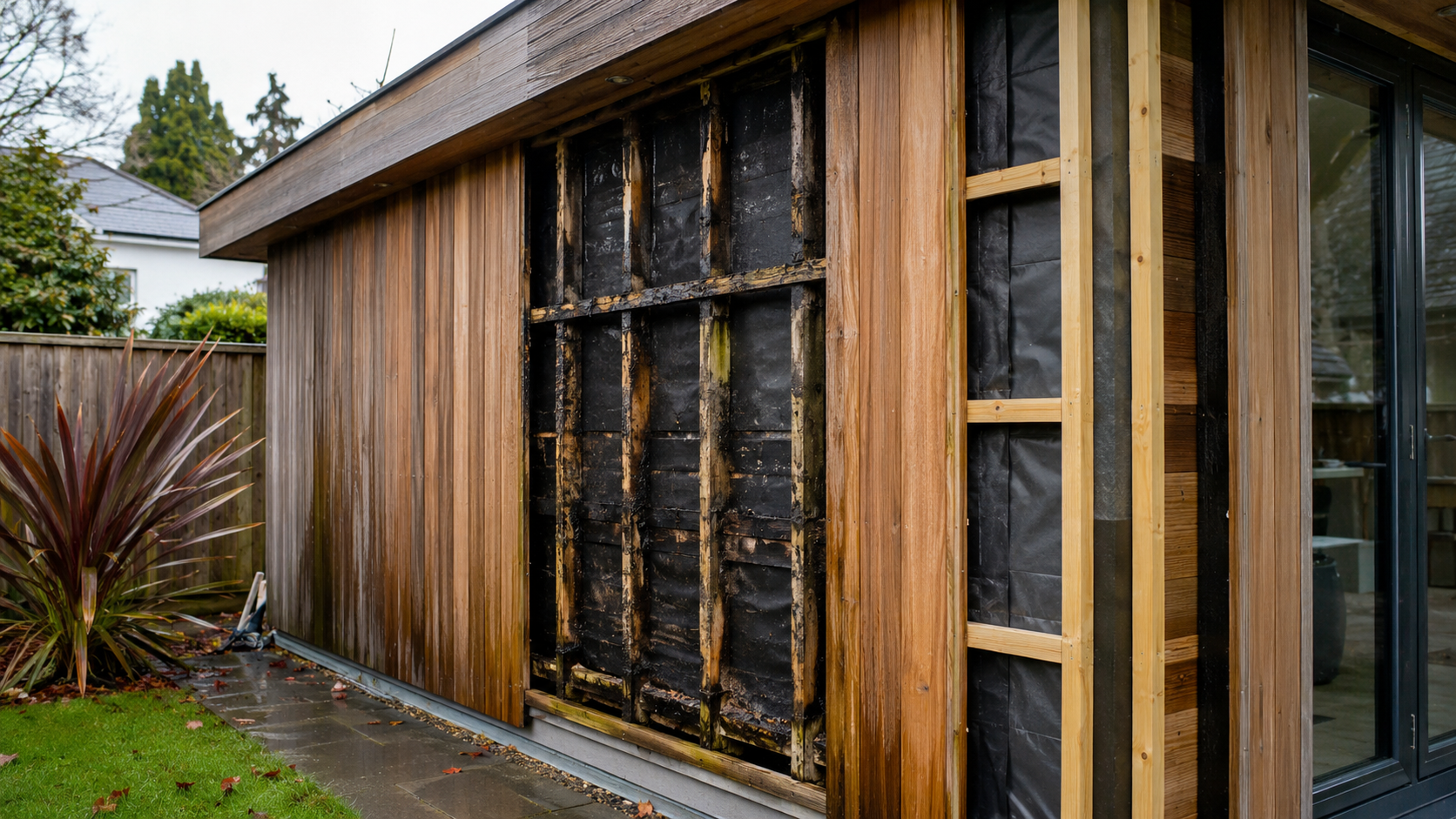
That's when we'd start looking at what's happening inside the wall.
Insulation Is Only as Good as the Gaps
People talk about insulation like it's one magic number.
Stick enough insulation in a building and it'll be warm.
Not quite.
Heat always looks for the easiest route out.
If most of your wall is highly insulated but you've created poorly detailed sections where heat can travel through more easily, those areas become colder than everything around them.
That's called thermal bridging.
And because the cold area often follows structural members, fixings or badly detailed junctions, the symptoms inside can appear in suspiciously straight lines.
That's your first clue.
Cold Surface Meets Warm Office
Now put somebody inside that garden room for eight hours.
They're breathing.
Kettle goes on.
Maybe there's a dog lying under the desk.
The air inside contains moisture.
Normally, no drama.
But when that warm moist air meets a significantly colder section of wall, the surface temperature can drop far enough for condensation to form.
You might not even see water running down it.
A consistently cooler, slightly damp surface can be enough to encourage mould and collect dirt.
That's why repeatedly spraying mould killer at the wall isn't necessarily solving anything.
You're cleaning the evidence.
SIPs Help Avoid the Problem — If They're Detailed Properly
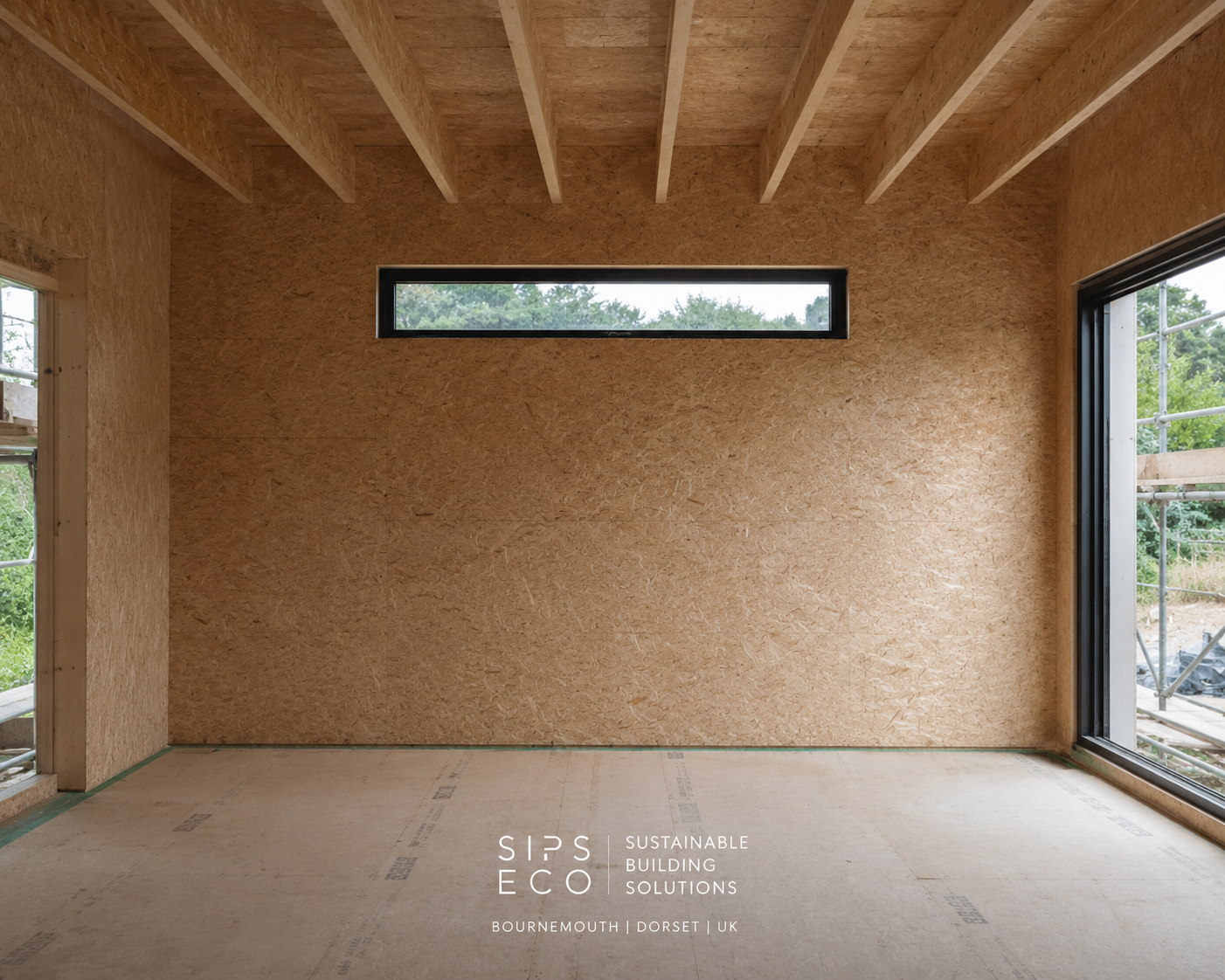
One of the advantages of a properly designed SIPs structure is continuity.
The insulation is integrated into the panel rather than somebody stuffing insulation between a forest of timber studs afterwards.
But that doesn't mean you can stop thinking.
Corners matter.
Floor-to-wall junctions matter.
Roof connections matter.
Doors and windows matter.
Anywhere the insulated envelope gets interrupted needs proper detailing.
You can buy brilliant panels and still create weak spots by joining everything together badly.
Same expensive materials.
Completely different finished building.
Don't Blame the Heating
This is where people make the problem worse.
Room feels cold.
Turn the heater up.
Now you've got even warmer internal air carrying moisture while that badly detailed strip of wall stays cold.
The temperature difference gets bigger.
Then somebody decides the answer is a dehumidifier permanently humming underneath the desk.
Again, maybe useful for controlling moisture.
But we'd rather know why that particular bit of wall is getting so cold in the first place.
A proper garden office should behave like a proper building.
Not a posh shed you have to babysit through every Dorset winter.
The Stuff You Can't See Matters Most
Customers understandably care about cedar cladding, bifolds, flooring and lighting.
We do too.
But once everything is finished, the most important parts of a garden studio are hidden.
Insulation continuity.
Junction details.
Moisture control.
Ventilation.
The thermal envelope.
Get those right and you walk into a comfortable office in January without thinking about any of them.
Get them wrong and the building eventually starts drawing the mistakes onto the plasterboard for you.
Stop letting cheap builders ruin your property. Pop down and see the lads at 78 Alma Rd, Bournemouth BH9 1AN, UK, or ring the site phone on 07840 151036.