The Green Wall: Why Your Expensive Garden Room is Growing Mould Behind the Cladding
Your garden room cladding can look perfect while the timber behind it is wet and turning black. Poor ventilation and trapped moisture can quietly cause serious damage where you can't see it.
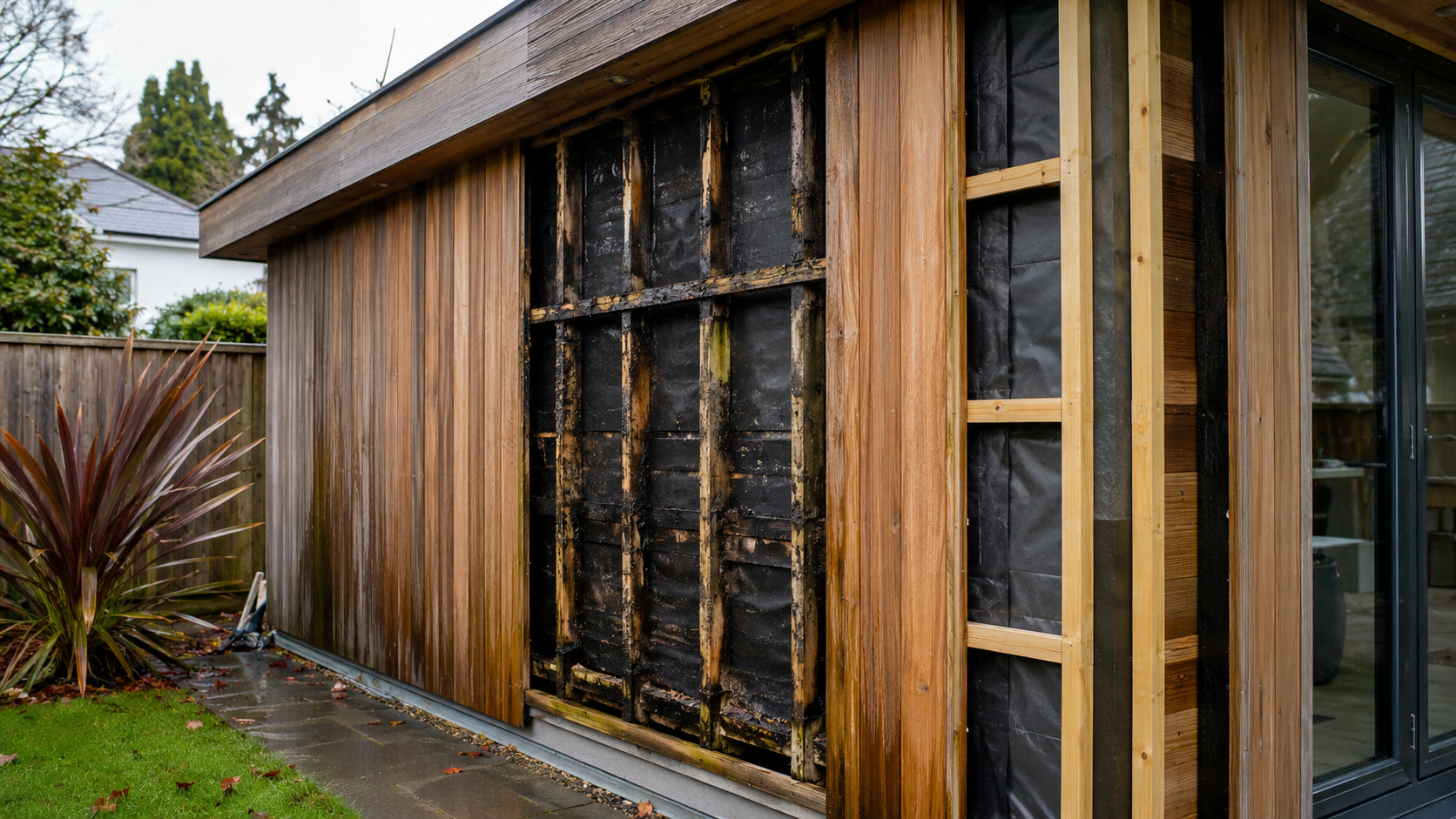
From the garden, everything looks fine. Nice cedar or composite cladding. Straight lines. No obvious leaks. Then somebody removes one board and finds black battens, damp timber and mould growing behind the lot.
We've seen people immediately blame the cladding. Usually that's not the real problem. The wall behind it was built wrong.
A garden room gets hammered by British rain all year. Water will get behind external cladding. That's normal. The important question is what happens to it once it's there.
The Gap Nobody Sees
Cladding shouldn't simply be screwed tight against the wall and forgotten about. Behind it you need a properly detailed weather-resistant layer and a cavity that allows moisture to drain and the construction to dry.
Cheap builders don't like invisible work. Customers can't see battens, membranes or ventilation once the last board goes on, so it's an easy place to save time and a few quid.
Fix the cladding without the correct cavity and you've created a lovely dark pocket behind it. Rain gets through joints. Condensation forms. Timber gets damp. But there's barely any airflow to dry it again.
Leave wet timber sitting in a dark space for long enough and you don't need to be a building scientist to work out what happens next.
Black mould. Rot. Soft battens. Eventually fixings start losing the timber they're supposed to be holding onto.
The outside can still look absolutely fine while this is happening.
Waterproof Doesn't Mean Airtight
Another mistake is trying to seal absolutely everything.
Builders love silicone. See a gap? Silicone it. See another one? More silicone.
But a properly built external wall isn't relying on one giant waterproof seal. It's designed in layers.
The cladding takes the worst of the weather. Behind that, the correct membrane protects the structure. The cavity gives any water that gets through somewhere to drain and allows air to move behind the boards.
You want moisture to get out.
Trap it between layers and you've built a damp box around your expensive SIPs garden studio.
Coastal conditions around Bournemouth and Poole don't make this any easier either. Wind-driven rain gets into places a gentle summer shower never will. The wall needs to be built expecting that.
The Cladding is Only the Skin
This is why we're obsessed with the boring bits of garden room construction.
Customers understandably care about the visible stuff. The bifolds. Cedar. Flooring. Lighting. Plastering.
We care about what sits behind it as well.
Correct membranes. Properly installed battens. Suitable ventilation and drainage. Details around windows, doors, corners and the bottom of the wall where water actually needs to escape.
Because replacing a piece of damaged cladding isn't particularly dramatic.
Discovering the timber structure behind your £30,000 garden room has spent three winters sitting wet is a completely different conversation.
If we're building something that's supposed to last for decades, it needs to be able to get wet and then dry properly.
Stop letting cheap builders ruin your property. Pop down and see the lads at 78 Alma Rd, Bournemouth BH9 1AN, UK, or ring the site phone on 07840 151036.