The Rocking Slab: Why Your Porcelain Patio Moves Under Your Feet
Your porcelain patio looks fine, but one slab clicks and moves when you stand on it. The base might not have failed at all — the porcelain may simply never have bonded to it properly.
Your patio looks fine.
No massive cracks. Nothing has obviously sunk. The porcelain still looks almost exactly like it did when the landscaper finished.
Then you step near the corner of one slab.
Click.
Put your weight on it again and you can physically feel the thing move underneath your boot.
That's not porcelain being flexible.
The slab has come loose.
The Mortar Can Still Be Rock Solid
This catches people out.
They assume a moving slab means everything underneath it must have collapsed.
Not necessarily.
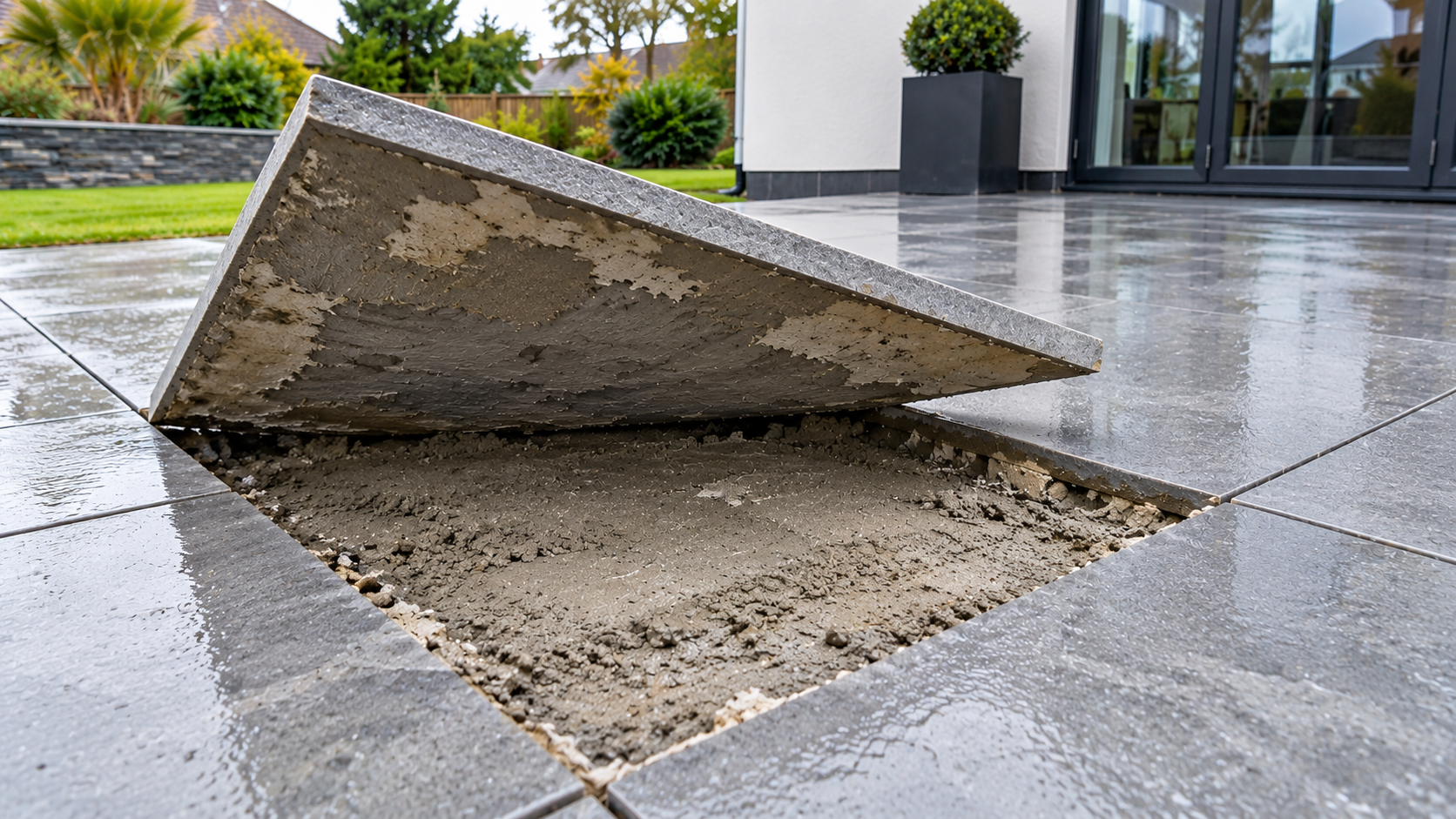
Sometimes you lift the porcelain and find a perfectly solid mortar bed sitting underneath.
The problem is the slab never properly bonded to it.
Porcelain is incredibly dense. That's brilliant once it's installed, but it also means you can't treat it like an old concrete paving slab and expect ordinary mortar to grab hold of the back.
It needs installing properly.
The Missing Slurry
One of the important bits is slurry primer.
Before porcelain goes onto the mortar bed, the back of the slab needs the correct bonding treatment to help create a proper connection between the porcelain and the bedding mortar.
Skip it and you can end up with something that looks absolutely fine when the job is finished.
The slab is heavy. The mortar underneath supports it. The joints around it help keep everything looking solid.
But the actual bond can be rubbish.
Eventually movement starts.
You might also get problems if the back of the slab is filthy, the mortar has started drying before the slab goes down, or somebody is laying in conditions they shouldn't really be working in.
Again, all the stuff you can't see once the patio is finished.
Click, Rock, Crack
The movement normally starts small.
A tiny click when you stand in the wrong place.
Then the joint around the slab starts breaking because rigid jointing doesn't particularly enjoy having a paving slab repeatedly rocking next to it.
Water gets into the opening.
More movement follows.
Eventually corners can chip, joints fail completely and neighbouring slabs can start being affected.
At that point, squirting something into the joint and hoping it'll hold everything still isn't a repair.
The loose slab needs lifting and the reason it failed needs sorting.
Porcelain Needs Installing Like Porcelain
This is why buying expensive paving doesn't guarantee an expensive patio.
You can spend thousands on beautiful porcelain and completely ruin the job with a shortcut involving a few quid's worth of bonding material.
Proper sub-base.
Proper mortar bed.
Clean slabs.
Correct slurry primer.
Correct working conditions.
Then the slab actually gets bedded and bonded properly rather than simply being placed on top and surrounded with jointing.
Most of that disappears the second the porcelain goes down.
Which is exactly why cowboys love cutting corners there.
You won't know they've done it.
Until your expensive new patio starts clicking underneath your feet.
Stop letting cheap builders ruin your property. Pop down and see the lads at 78 Alma Rd, Bournemouth BH9 1AN, UK, or ring the site phone on 07840 151036.