The Full Sponge: Why Bournemouth Soakaways Stop Working After Weeks of Rain
A soakaway isn't a bottomless drain. After weeks of Bournemouth rain, saturated ground can simply stop accepting more water. That's when patios, channels and lawns start backing up.
Your garden drainage worked perfectly all summer.
Patio channels emptied. Lawn stayed firm. Heavy shower came down and disappeared.
Then Bournemouth gets weeks of rain.
Suddenly the lawn is like soup. Water is sitting in the channels and the patio takes hours to clear.
First assumption?
The soakaway must be blocked.
Maybe.
But sometimes there's absolutely nothing wrong with the soakaway.
The ground around it is simply full.
A Soakaway Isn't a Bottomless Pit
This is the bit people misunderstand.
A soakaway doesn't make water disappear.
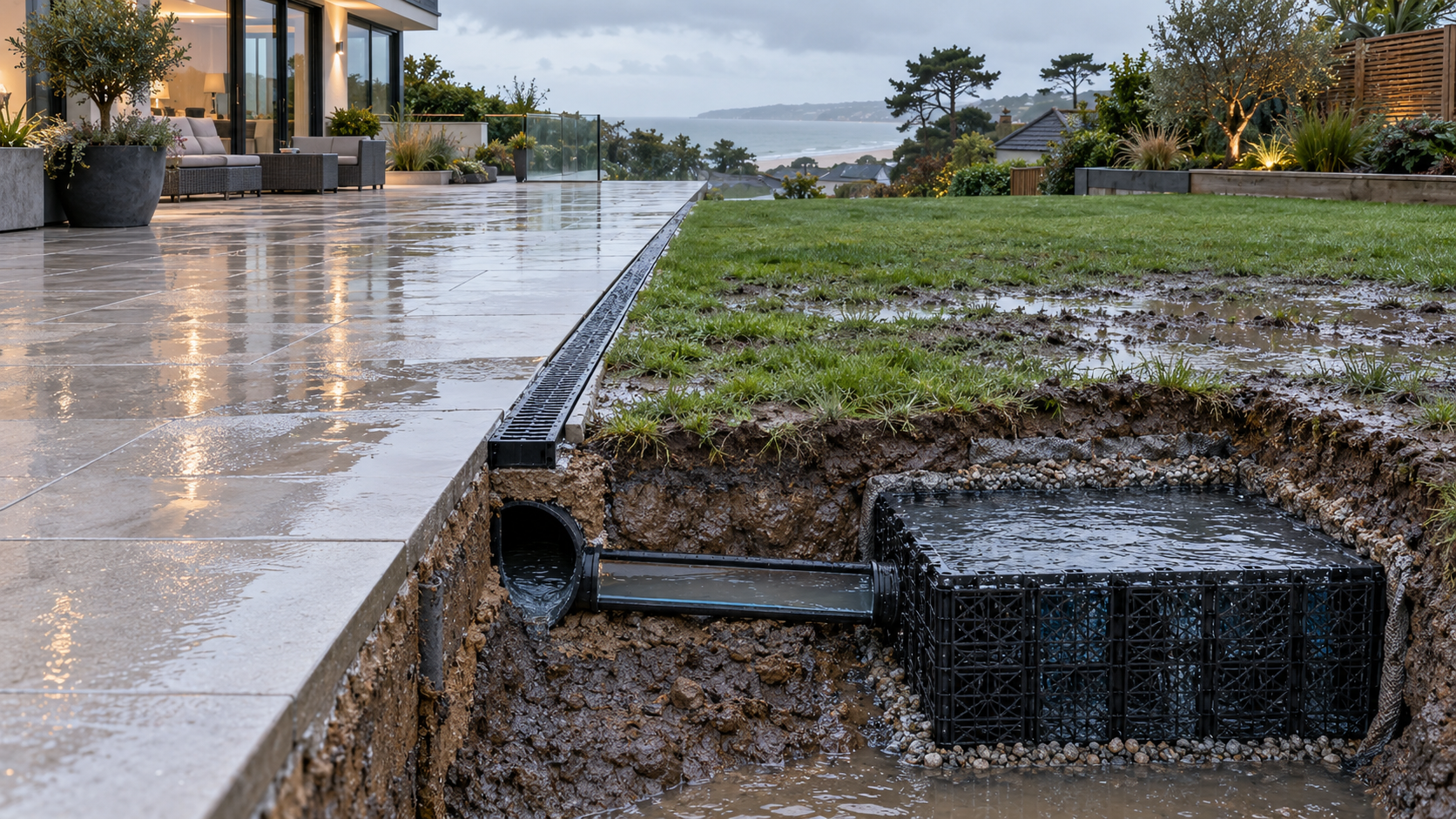
All it's really doing is giving rainwater somewhere to sit while the ground around it slowly takes that water away.
And how well that works depends entirely on the ground.
After a dry spell, the soil can usually take plenty of water.
After weeks of rain, it's a different story.
Once that ground is soaked through, there's only so much more water it can take.
The soakaway can still fill exactly as it was designed to. The trouble is, the water already inside it isn't getting away fast enough before the next lot arrives.
Eventually, something has to back up.
Then the Patio Drain Stops Draining
This is where homeowners start blaming the channel drain.
There's water sitting in it, so obviously the drain has failed.
Except the channel might be doing exactly what it should.
Water has travelled off the porcelain, into the channel and through the pipework.
The issue can be further down the line.
If the soakaway has nowhere left to send that water, everything feeding into it begins to slow down as well.
That's when you'll find water hanging around in the channels or sitting inside the pipework.
Give it another few days of Bournemouth rain and puddles can suddenly appear in parts of the garden that had been completely dry all summer.
Digging a Bigger Hole Isn't Always the Answer
This is where the cowboy solution arrives.
Garden's wet?
Dig a bigger soakaway.
That might help in the right conditions.
It might also give you a bigger hole full of exactly the same water.
Before relying on soakaway drainage, you need to understand the ground.
How quickly does water actually infiltrate?
What soil are we dealing with?
What area of patio, roof or driveway is feeding the system?
Where's the groundwater?
What happens after several days of sustained rain rather than one summer shower?
Those questions matter because drainage has to work when the garden is getting hammered, not just when the ground underneath it is bone dry.
Drainage Starts With the Ground
This is why we don't treat garden drainage as a case of burying a plastic crate and calling it done.
The soakaway is only one part of the system.
Levels matter. Falls matter. Ground conditions matter. The amount of water being collected matters.
And sometimes the site itself dictates that a simple soakaway isn't going to solve everything.
You need to know that before £20,000 worth of porcelain, walls and landscaping goes over the top.
Because once the garden is finished, discovering that the ground can't take the water becomes considerably more expensive.
A soakaway gives rainwater somewhere to go.
But if the ground around it is already soaked, that water still has to wait its turn.
Stop letting cheap builders ruin your property. Pop down and see the lads at 78 Alma Rd, Bournemouth BH9 1AN, UK, or ring the site phone on 07840 151036.