The Gravel Patch: Why Your Resin Driveway is Going Bald
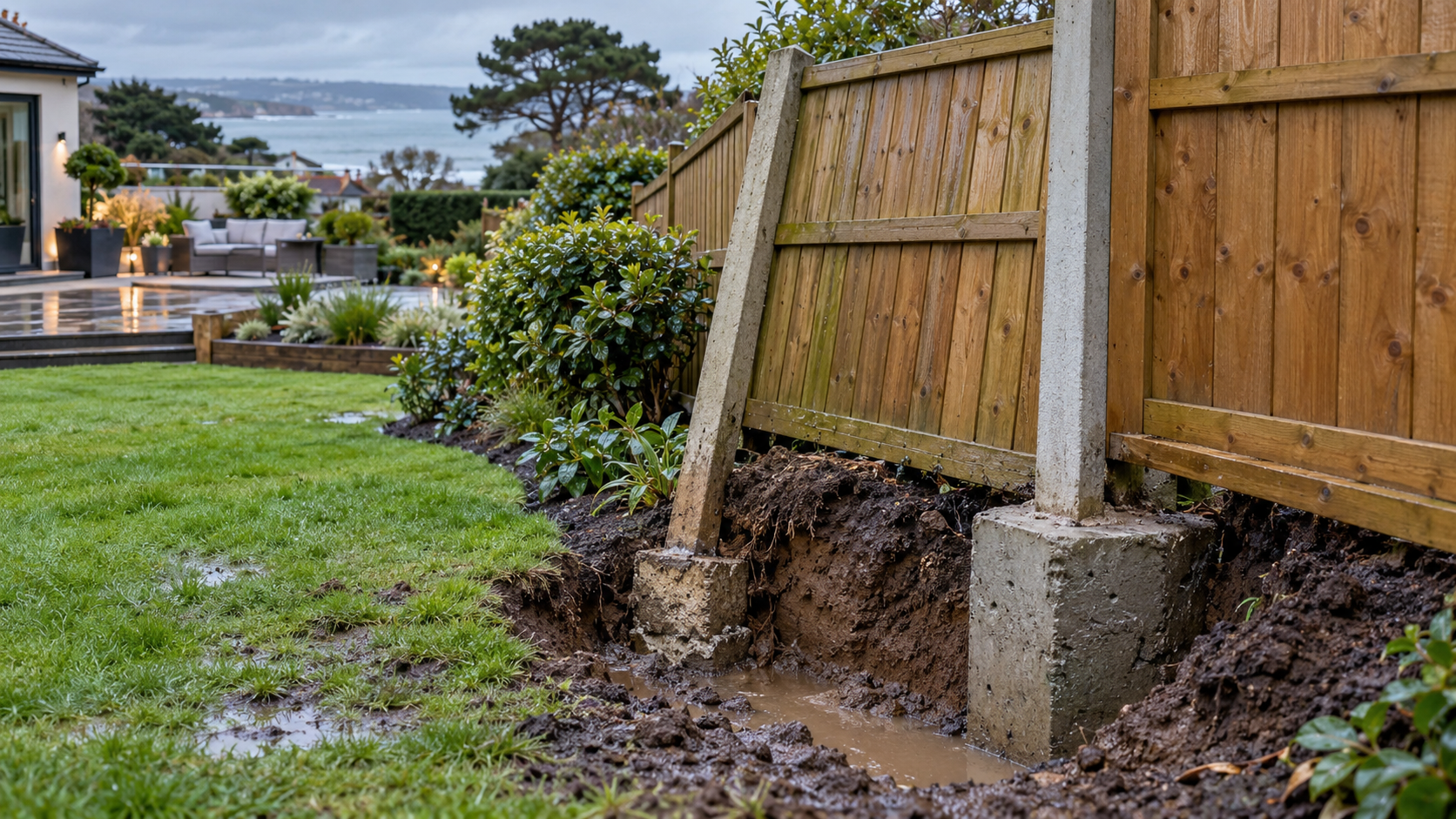
Concrete fence posts don't rot, but they can still move. Shallow foundations, saturated Dorset ground and repeated wind can leave an expensive new fence leaning after only a couple of winters.
Concrete posts.
Gravel boards.
Decent fence panels.
Customer thinks they've bought the indestructible version.
Then Bournemouth gets through a wet winter and one post starts leaning.
By spring, three panels are running downhill and the whole fence looks pissed.
Everyone blames the wind.
Sometimes the wind only exposed what was already wrong underground.
Concrete Posts Aren't Magic
People assume switching from timber posts to concrete solves everything.
It solves rot.
It doesn't solve rubbish foundations.
A concrete post is basically a long lever sticking out of the ground. You've got nearly two metres of fence above ground catching wind and transferring that force straight down into the base.
If the hole is too shallow, too narrow or filled with a pathetic amount of concrete, the post can move.
Once one starts leaning, the panels connected to it start putting pressure on the next post.
Now the whole run begins looking rough.
Wet Dorset Ground Finds the Shortcut
This gets worse when the ground stays wet.
After prolonged Bournemouth rain, soft saturated soil doesn't provide the same resistance as firm ground.
If somebody has dug a tiny hole, dropped the post in and thrown a bit of post mix around it, you've got a heavy fence relying on a small lump of concrete sitting inside soft muck.
Wind pushes the fence.
Post moves slightly.
Ground around the foundation opens up.
Water gets into the disturbed soil.
Next storm moves it again.
You don't need the post to suddenly fall over.
A few millimetres of movement repeated through winter is enough to leave a fence noticeably leaning by spring.
The Hole Matters More Than the Panel
Customers spend ages choosing fence panels.
Horizontal.
Hit-and-miss.
Feather edge.
Decorative slatted cedar.
Fair enough.
We're interested in the holes.
How deep are the posts going?
What ground are we dealing with?
How exposed is the garden?
How tall is the finished fence?
What's happening with the levels?
A six-foot solid fence on an exposed Bournemouth property needs treating differently from a short decorative screen tucked behind a garage.
The more wind the fence catches, the more important everything underneath becomes.
You don't fix that by buying a more expensive panel.
Straight Today Isn't Good Enough
Anybody can make a fence look straight while the concrete is wet.
String line out.
Spirit level on the post.
Take a photograph.
Lovely.
The test comes after a couple of winters.
Proper post depth, adequate foundations and sensible spacing are what keep the fence where it was originally built.
And if the garden is exposed, sometimes allowing some wind through the design makes considerably more sense than building a giant solid wall and expecting the foundations to fight every storm.
That's the difference between installing a fence and actually thinking about how it's going to behave.
Because concrete posts can last decades.
But only if the bloke installing them puts enough of the bloody things in the ground.
Stop letting cheap builders ruin your property. Pop down and see the lads at 78 Alma Rd, Bournemouth BH9 1AN, UK, or ring the site phone on 07840 151036.